
The number the headlines never mention: By 2030, AI will displace 92 million jobs and create 170 million new ones. That’s a net increase of 78 million jobs globally. Source: World Economic Forum Future of Jobs Report 2025.
Let’s get the scary part out of the way first.
Yes, AI is replacing tasks. Yes, some roles are shrinking. Yes, the workplace is changing faster than most people expected.
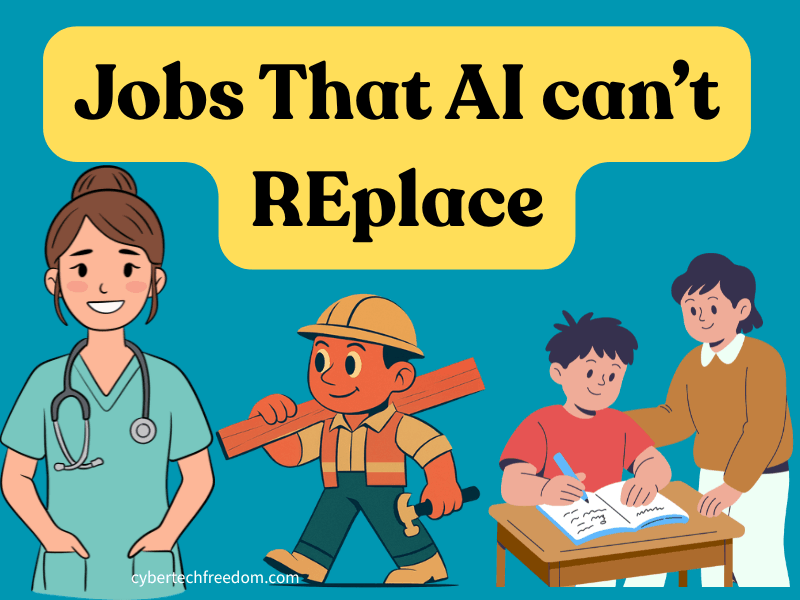
But here’s what the alarming headlines leave out: AI may be replacing certain tasks, but it isn’t replacing careers. This is an important distinction, especially if you’re a nurse, a teacher, a tradie, a carer, or anyone who works with real people in the real world every day. cybertechfreedom
This post covers the jobs that AI can’t replace, why they’re protected and most importantly what you can do right now to make yourself harder to replace regardless of what field you’re in.
Why Some Jobs Are AI Safe And Others Aren’t
Before we get to the list, it helps to understand why certain jobs resist automation.
What makes a career AI-proof comes down to a few structural barriers: physical presence requirements, licensing and legal accountability, the need for human judgment in unpredictable situations, and relational trust that technology simply cannot replicate.
In plain English, AI struggles with anything that requires:
- Being physically present in an unpredictable environment
- Reading human emotion and responding with genuine empathy
- Making judgment calls where the stakes are high and the situation is new
- Being legally accountable for an outcome
- Building trust with a specific person over time
If your job involves any of these you’re in a stronger position than the headlines suggest.
On the other side, roles built primarily around repetitive data entry, simple document processing, or high-volume templated communication face the most automation pressure. USCareerInstitute
Jobs that AI Can’t REplace
1. Skilled Trades — Electricians, Plumbers, HVAC, Mechanics
The short version: Trades score 91/100 on AI resistance. Physical unpredictability is the single strongest protection factor against automation — and trades face a growing skills shortage that AI won’t solve.
Think about it practically. An AI cannot crawl under a house to fix a burst pipe in a 1960s renovation where nothing is standard. It cannot rewire a switchboard when every building is different. Every job is different. Every environment is unpredictable.
Electricians are seeing outsized demand from data centers and electric vehicles, 9% projected growth with strong employment outlook. Trades also face a workforce shortage that AI won’t solve. Demand is rising while fewer young people are entering these fields.
What this means for you or your child: Trades are not a backup plan. They are one of the most economically secure, automation-resistant career paths available with apprenticeship entry, no university debt, and growing demand. The social stigma around trades is a holdover from a world that no longer exists.
2. Mental Health Professionals — Therapists, Counsellors, Psychologists, Social Workers
The short version: Mental health professionals score 97/100 on AI resistance — the highest of any profession. The therapeutic relationship cannot be automated because it IS the product.
A counsellor’s value is not information delivery. It’s attunement, trust, moral accountability, and the ability to read what a person cannot say. No regulatory framework will permit AI to hold personal liability for care outcomes.
A global mental health workforce gap is widening as more people seek care. Demand for qualified mental health professionals is growing, not shrinking as loneliness and anxiety rise globally.
What this means: Your skills are becoming more valuable, not less. The demand for human connection is rising because of AI, not despite it. That creates need, not obsolescence.
3. Nurses and Healthcare Workers
The short version: Nursing is not one job. Theatre nursing faces real change. Aged care, mental health, community, and midwifery nursing are among the most protected careers that exist. Know the difference.
Healthcare is often misunderstood in AI discussions. AI is becoming extremely good at analyzing medical data but healthcare isn’t only about data. It’s about people.
A nurse comforting a frightened patient, recognising subtle changes in someone’s condition, or helping a family through a difficult moment is doing work that goes far beyond technology.
The strongest healthcare careers for the future include:
- Aged care nursing
- Community nursing
- Mental health nursing
- Midwifery
- Paediatric nursing
These roles combine medical expertise with human connection, making them highly resistant to automation.
The BLS projects 8.4 percent growth for healthcare from 2024 to 2034, nearly three times the economy-wide average. Nursing, physical therapy, and mental health counseling are among the safest roles.
4. Cybersecurity Professionals
Cybersecurity is one of the fastest-growing fields in the world. Many people assume AI will eventually handle security on its own.
The reality is more complicated. Cybercriminals are using AI too.
Every time defensive tools improve, attackers adapt. That means organizations still need people who can think creatively, investigate unusual behaviour and respond to threats that haven’t been seen before. The ability to anticipate what might happen next remains a uniquely human advantage.
For people considering a career change, cybersecurity also offers pathways through certifications and practical experience rather than requiring a traditional university degree.
5. Teachers and Educators
The short version: AI can deliver information. It cannot build the relationship that makes a struggling student decide to keep trying. That part is yours and it’s becoming more valuable.
AI can generate a lesson plan in seconds. It can quiz a student and mark a test instantly. What it cannot do is notice that a child hasn’t spoken in three days and something might be wrong at home.
A teacher notices when a child is struggling. A teacher builds confidence.
A teacher creates an environment where students feel safe enough to learn.
The WEF Future of Jobs Report 2025 projects education roles to grow 15-25% through 2030 despite AI automation.
What this means for teachers: As AI delivers more information, human educators become even more important because they help students develop critical thinking, resilience and social skills. Those qualities matter far more than memorizing facts.
6. Carers – Aged Care, Disability Support, Childcare
Caring for an elderly parent. Supporting a person with a disability through a difficult day. Helping a toddler feel safe and loved. These are not tasks. They are relationships. And relationships require humans.
Aged care faces massive demand growth as populations age and a persistent workforce shortage that AI cannot fill.
What this means: Caregiving is among the most protected work that exists. The challenge in this sector has never been replacement — it’s pay and recognition. The employment outlook is as strong as anywhere in the economy.
7. Legal Professionals – In the Right Roles
The short version: Document processing is changing. Advocacy, ethical judgment, and client relationships are not. Move deliberately toward the human layer of your practice.
AI is already handling legal research and contract review faster than junior associates. That part of the legal profession is genuinely changing.
But a judge cannot be an algorithm. A mediator resolving a family dispute cannot be replaced by a chatbot. A lawyer who knows their client’s full situation- the things that don’t make it into documents and cannot be substituted by a system that only reads what’s written.
The honest breakdown: Roles primarily built on document processing face the most transformation. Roles built on advisory, advocacy, ethical judgment, and client relationships are irreplaceable.
What Should Our Kids Study? A Framework for Parents
This may be the most important part of the entire discussion.
Instead of asking: “What job should my child study for?”
Ask: “What skills will still matter no matter how technology changes?”
The short version: Don’t pick a safe degree. Develop capabilities that matter in any field. The goal is to become someone who creates value machines can’t replicate — in whatever area they choose.
The WEF Future of Jobs Report 2025 projects that 39% of existing skill sets will become outdated between 2025 and 2030. But 85% of employers plan to priorities workforce upskilling, meaning the skills that matter can be learned, not just inherited.
Three career categories that will matter regardless of field:
Category 1: Work requiring physical presence in unpredictable environments
These roles are automation-resistant because AI cannot inhabit a body in a changing physical world:
- Physiotherapy and occupational therapy
- Sports coaching and athletic training
- Emergency services — paramedics, firefighters
- Veterinary medicine
- Fieldwork science — marine biology, conservation, environmental science
- Forensic investigation
- Midwifery and maternity care
Category 2 : Work built on human trust relationships over time
Where the relationship is the service:
- Psychology and counselling
- Financial advice built on deep client knowledge
- General practice medicine
- Social work and community services
- Early childhood and special education teaching
- Family law and mediation
- Palliative and aged care
Category 3 : Work that manages, questions, and governs AI itself
The category most parents haven’t considered. These roles don’t require engineering degrees — they require critical thinking, ethics, communication, and domain expertise:
- AI ethics and policy work
- Healthcare informatics
- Legal technology roles
- Educational technology design
- Technology journalism and communication
- Government and regulatory roles overseeing AI
The five skills that cut across everything:
1. Critical thinking under uncertainty Making good decisions when the answer isn’t obvious. Developed through debate, philosophy, and being allowed to struggle with hard questions without being rescued immediately.
2. Genuine human connection Making people feel heard, understood, and supported. Developed through real relationships and community involvement not screens.
3. Deep expertise in something specific One field known deeply, combined with AI literacy to work within that field intelligently. A nurse who understands AI diagnostic tools. A teacher who uses AI to personalise learning.
4. The ability to explain complexity clearly Taking complicated information and making it genuinely understandable to a non-expert. One of the most durable skills that exists because AI produces complexity faster than ever and humans are needed to translate it.
5. Ethical judgment As AI systems make more decisions affecting people’s lives, someone has to decide whether those decisions are right. That requires humans with values not just algorithms with data.
A Simple Exercise You Can Do This Week
Write down the tasks you perform in your current job and divide them into two lists.
Tasks AI may help automate
- Repetitive
- Predictable
- Administrative
- Data-heavy
Tasks that depend on you
- Judgment
- Relationships
- Communication
- Leadership
- Problem-solving
The second list is where your future value lives.
The goal isn’t to compete with AI. The goal is to use AI while strengthening the skills only humans can provided.
The Bottom Line
AI is not coming for your career. It’s coming for the parts of your career that never really needed you in the first place.
The repetitive, predictable, processable parts those are changing. The parts that require you to be physically present, emotionally intelligent, legally accountable, and genuinely human those are becoming more valuable.
The workers who struggle won’t be the ones whose tasks get automated. They’ll be the ones who waited to find out rather than asking the question now. No body knows for 100% what future hold for us but one thing is sure AI is here and its already seeped into our life. The best thing to do is to learn it, master it and use it to make our life better.
the question. That puts you ahead
- Will AI Take My Job? The Honest Answer for Everyday Workers (coming soon)
- AI Anxiety: When Thinking Becomes Optional
- Human-in-the-Loop Careers: How to Stay Relevant in 2026
- AI Safety for Families – Complete Hub
Frequently Asked Questions
What are the jobs that AI can’t replace?
The strongest categories are healthcare workers, skilled tradespeople, teachers, mental health professionals, legal professionals in advisory roles, carers, and cybersecurity specialists.
What these roles share is physical presence, human judgment, emotional connection, or legal accountability none of which AI can replicate.
What jobs can’t be replaced by AI in Australia?
The same categories apply in Australia with particular strength in aged care, nursing, trades, teaching, and disability support, all of which face workforce shortages that AI won’t solve. Demand in these fields is growing while supply remains tight, making them among the most secure employment options available.
What skills will protect my job from AI?
The five most AI-resistant skills are critical thinking in ambiguous situations, emotional intelligence and human connection, complex problem-solving, the ability to explain reasoning clearly, and AI literacy. Knowing how to use AI tools to extend your own capability rather than compete with them.
Will AI take my job completely?
For most people -No. The more accurate picture is that AI will change what your job involves. Repetitive and processable tasks will be automated.
The human judgment, relationship, and accountability parts will remain. The workers who adapt well are the ones who deliberately move toward the human parts of their work and let AI handle the rest.
What jobs will disappear due to AI by 2030?
Roles built primarily on data entry, routine document processing, templated customer service, basic research, and commodity writing face the most transformation. This doesn’t mean everyone in those fields loses their job but it does mean those specific functions will require fewer people, and the remaining roles will require broader skills.
I’m not in any of the safe categories – what should I do?
Do the three-step career audit in this post. Identify which parts of your current role require genuine human judgment, presence, or connection and start developing those deliberately. Most roles have a human layer that’s underused because the repetitive tasks take all the time. AI clearing those tasks is actually an opportunity to move into more valuable work.
References:
WEF Future of Jobs Report 2025
BLS Employment Projection 2024-2034
Top 65 Jobs Safest from AI & Robot Automation
What jobs will AI replace? Tips to future-proof your career
AI adopters aren’t cutting jobs, they’re creating them


As somebody who is skeptical when it comes to AI, this was a nice read!
AI has a ways to go to until it takes over peoples positions. I think we are still in the early stages of the technology. Its helping in some respect but still early stages.