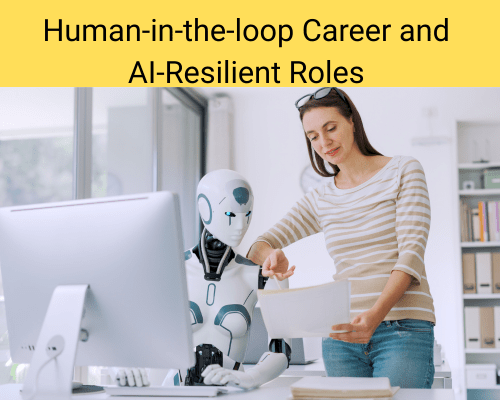

There’s a phrase quietly appearing in job listings right now that most people scroll past without understanding.
“Human in the Loop Jobs.”
If you’ve seen it and wondered what it means or whether it applies to you then this post is for you.
Because here’s the thing nobody tells you: if you’ve ever reviewed an AI-generated output, escalated an edge case, or validated a recommendation before delivery – you’ve already been working in a human-in-the-loop model. You just didn’t know what to call it.
Today, this skill set is becoming one of the most sought-after in the workplace.
So What Does “Human in the Loop” Actually Mean?
In plain English, human in the loop jobs means a human being is built into an AI process to check, guide, correct, and approve what the machine produces.
AI is fast. AI is powerful. But AI also makes mistakes sometimes subtle ones, sometimes expensive ones.
In 2025, Deloitte published an AI-generated report containing fabricated citations and a quote that never existed. This incident forced the firm to refund the Australian government and triggered national media coverage. One unchecked AI output became a credibility crisis. Articuler
That’s why organizations are not simply letting AI run on its own. They’re building humans into the process at critical checkpoints – to catch what the machine gets wrong, apply context the machine doesn’t have, and take responsibility for the outcome.
That human is the person in the loop.
And that person needs to be you.
Why This Matters Right Now
The human-in-the-loop market is growing fast, from $4.1 billion in 2025 to a projected $12.5 billion by 2027. The EU AI Act now mandates human oversight for high-risk AI applications. And 70% of customer experience leaders plan to integrate AI across touchpoints by 2026 — most with built-in human review layers. askfilo
This is not a niche tech trend. It’s the scaffolding being built around virtually every AI deployment in every regulated industry.
AI hallucinations alone cost enterprises $67.4 billion in losses in 2024. The real money in 2026 isn’t in making the AI work. It’s in knowing exactly when the machine is lying to you. National University
The workers who benefit most from this shift are not necessarily the ones who know how to build AI. They’re the ones who know their field deeply enough to know when AI gets it wrong.
What Human in the Loop Jobs Actually Look Like
What’s new in 2026 is that human-in-the-loop roles are no longer limited to data annotation or content moderation. They’re spreading into mainstream professional roles and the people filling those roles are being compensated accordingly.
Here’s what this looks like in everyday workplaces:
In healthcare: A doctor reviews AI-generated diagnostic suggestions before they reach a patient. A nurse flags when an AI medication alert doesn’t match what she’s seeing at the bedside. A healthcare administrator checks AI-generated billing codes before submission.
In legal and compliance: A legal analyst reviews AI-drafted contract summaries before a client receives them. A compliance officer checks AI-generated risk assessments against their knowledge of the actual business context.
In marketing and content: An editor reviews AI-generated copy for accuracy, brand voice, and context before it goes live. A strategist evaluates whether an AI content recommendation actually makes sense for this specific audience.
In finance: An adviser reviews AI-generated investment recommendations against their knowledge of a client’s actual situation — the things that don’t show up in the data.
In education: A teacher reviews AI-generated lesson plans and adapts them to the specific students in front of them — the ones who need more support, the ones who are bored, the ones who learn differently.
The pattern is the same across every industry: AI produces the output, a human applies judgment, context, and accountability before it goes any further.
The Three Things That Make You Irreplaceable in This Model
You don’t need to understand how AI works to be valuable in a human-in-the-loop role. You need three things.
1. Domain expertise — knowing your field well enough to catch what AI gets wrong
AI is trained on averages. It produces outputs that are statistically likely, not necessarily correct for your specific situation.
A nurse who has worked in aged care for ten years knows when a medication alert doesn’t account for this particular patient’s history. A lawyer who has handled family disputes for fifteen years knows when an AI contract clause is technically correct but practically disastrous.
That deep field knowledge is exactly what makes you the essential checkpoint in the process.
This week’s action: Write down three situations in your current job where you’ve overridden a system recommendation or caught an error that the system missed. Those moments are your human-in-the-loop value in action even if nobody called it that.
2. The ability to spot when AI is confidently wrong
Generating a report is no longer a secure career path. Ensuring that report is factually accurate, ethically sound, and strategically relevant is the definition of the gold collar class. National University
AI produces outputs with the same confident tone whether it’s right or wrong. Most people don’t question a well-written answer. The person who does – who reads it and thinks “that doesn’t sound right, let me check” is the person organizations need most right now.
Ask yourself this question about any AI output you work with:
“Did this require a soul or just electricity?”
If the answer is electricity, it needed you to check it. That checking is your value.
This week’s action: Next time you use an AI tool for any work task, deliberately find one thing it got wrong or missed. Practise the habit of verification rather than acceptance.
3. Knowing when to stop the machine
AI doesn’t know when it’s about to cause a problem. It doesn’t know a client is having a difficult week. It doesn’t know a strategy feels off. It doesn’t know the context behind the data.
You do.
Human-in-the-loop AI is not a philosophy. It is a workflow model where people guide, refine, and quality check AI outputs at every stage — and the human-in-the-loop layer is not a quality-of-life improvement. It is risk infrastructure.
Knowing when to pause, push back, escalate, or override the AI output that judgment is yours. It cannot be automated because it requires understanding why something matters, not just what it says.
This week’s action: Identify one AI tool used in your workplace or daily life where no human is currently checking the output. That gap is an opportunity to add value.
The Boredom Audit – What to Stop Doing Right Now
Here’s the practical flip side of everything above.
If you’re spending significant time on tasks that are repetitive, predictable, and require zero judgment – you’re spending time on work that AI is already better at than you.
That’s not a criticism. It’s an opportunity.
Do this audit this week:
Write down every task you do in a typical week. Sort them into two columns:
| Tasks that require my judgment, relationships, or expertise | Tasks that are repetitive, predictable, and data-based |
|---|---|
| These are your human-in-the-loop value | These are candidates for AI assistance |
Then for every task in the second column, ask: “Could an AI tool handle this draft and I handle the review?”
If yes that’s your efficiency gain. The time you free up from column two is the time you invest in getting better at column one.
Your new job isn’t to do the work. It’s to review, steer, and decide.
What Human in the Loop Jobs Pay
Human-in-the-loop roles currently range from $37,000 to $90,000 depending on seniority, industry, and the complexity of oversight required. bu
But the more important number is the direction, these roles are growing in value as AI deployment accelerates. When you see human-in-the-loop language in a job posting, the tasks listed will usually describe things like “review AI-generated outputs,” “escalate edge cases,” or “validate recommendations before delivery.”
Those are not entry-level tasks. They require judgment, domain expertise, and accountability — which is exactly why they pay above average for their category.
How to Position Yourself for Human in the Loop Roles
You don’t need a new degree. You need to reframe what you already do.
Step 1 — Identify your domain expertise What do you know deeply enough to catch AI mistakes in? That specific knowledge is your most valuable asset in this market.
Step 2 — Build AI literacy in your field You don’t need to know how to code. You need to know what AI tools exist in your industry, what they’re commonly used for, and where they typically go wrong. Most of this knowledge comes from using the tools yourself. Start with free versions of ChatGPT, Copilot, or whatever is relevant to your field.
Step 3 — Make your oversight visible Start documenting when you catch AI errors, improve AI outputs, or apply judgment that the system couldn’t. These are your human-in-the-loop credentials even without a formal title.
Step 4 — Update how you describe your work If you review AI outputs, validate recommendations, or apply expertise to automated processes say so explicitly. In your LinkedIn profile, your resume, and conversations with your manager. The language matters because hiring managers are now actively searching for it.
Check the list of jobs/career that are AI -proof and skills you can develop to protect your career.
The Bottom Line
The question most workers are asking is “will AI take my job?”
The better question is “how do I become the human the AI needs?”
Even in highly automated environments, humans play key roles in sensing, surfacing, and resolving issues in complex systems. They are vital to maintaining, updating, and improving what the machine produces. Careery
That role, the human who catches what the machine misses, applies context the algorithm doesn’t have, and takes responsibility for the outcome, is not going away.
It’s growing. It’s being formalised. And it’s being paid accordingly.
The workers who thrive in the next decade won’t be the ones who competed with AI. They’ll be the ones who made themselves essential to it.
Related Reading
- Jobs That AI Can’t Replace – An Honest Guide for Workers and Parents
- AI Anxiety: When Thinking Becomes Optional
- AI Safety for Families, a complete hub
- How can AI help in Job serach
Frequently Asked Questions
What are human in the loop jobs?
Human-in-the-loop jobs are roles where a person is built into an AI process to review, check, correct, and approve what the machine produces before it has real-world consequences. They exist because AI makes mistakes and organizations need qualified humans to catch them.
Do I need technical skills for human in the loop roles?
Not necessarily. The most important qualification is deep knowledge of your own field enough to recognize when AI gets something wrong.
Technical literacy helps but domain expertise is what makes you irreplaceable as the checkpoint in the process.
Are human in the loop jobs growing?
Yes, significantly. The human-in-the-loop market is projected to grow from $4.1 billion in 2025 to $12.5 billion by 2027. Regulatory requirements like the EU AI Act are mandating human oversight for high-risk AI applications, driving demand across healthcare, legal, financial services, and education.
What’s the difference between human in the loop jobs and regular jobs?
In a human-in-the-loop role, working with AI outputs is an explicit part of the job description, not just something that happens occasionally.
You are specifically responsible for the review, validation, or governance layer that sits between AI output and real-world delivery.
What industries have the most human in the loop jobs?
Healthcare, legal and compliance, financial services, marketing and content, education, and government are currently the highest-demand industries. Any regulated industry where AI errors carry real consequences needs human oversight built in.
How do I get a job in AI without a degree?
You don’t need a computer science degree to work in AI-adjacent roles. What you need is deep knowledge of your own field like healthcare, law, finance, education, marketing combined with enough AI literacy to know when the machine gets it wrong.
Start by using free AI tools in your current work, document where you add judgment or catch errors, and reframe that experience on your LinkedIn and resume using human-in-the-loop language.
Hiring managers are actively searching for that skill set right now, regardless of your educational background.
A curated Family Safety Toolbox with free cybersecurity tools and trusted products to protect your data, prevent identity theft, and stay safe online—at home or while traveling.



AI has got us all thinking about What’s next, for sure. Thank you for this thought-provoking article! I’m learning to understand aI better. And as a writer, i know it’s the empathy that aI can’t match. It can try, but we still need human compassion in everything we do🥰
Yup, you got it Kat. Empathy, feeling and emotions are the only thing that machine cant mimic so far.
It is scary to see AI taking over so many jobs that we relished. It is so important to find ways to incorporate it into our daily work routine without losing part of ourselves. Thanks for sharing.